Sterilization is a permanent method of birth control which can be performed on women as well as men. Read on to learn more about sterilization.
Surgical sterilization is the most effective form of birth control and the most final. Therefore, it is imperative that men and women who opt for this method of birth control be absolutely certain that they do not want children. This is not something you can change your mind about after it has been done.
Making the Decision
This is not an easy decision to make. You will probably vacillate over the decision, constantly asking yourself if you are doing the right thing. Do not hesitate to speak to your doctor and clarify all your doubts, even if you have to call him several times. This is perfectly normal because it is quite an important decision to make. In effect, you are closing off the option of having children permanently.
Couples who usually go in for the sterilization option are those who feel that their family is complete and they are sure that they do not want more offspring. Surgical sterilization may be advised for women who may be at risk if they become pregnant.
However, keep in mind that fertility declines rapidly once a woman is past her child-bearing age (around her mid-forties). Thus, she may only need to use contraception for the next few years. In such a case, undergoing a surgery for the purposes of birth control may be quite a drastic decision and probably unnecessary in the long run. In addition, you must consider the fact that you might marry a little later in life, or even remarry.
Remember that male sterilization, known as a vasectomy, is also an option. This may be slightly less risky, less expensive, and only slightly less effective than female sterilization.
How is sterilization carried out in women?
Sterilization is done in females by cutting or blocking the tubes which carry eggs. These tubes are known as fallopian tubes. Due to the blockage in the tubes the eggs are prevented to meet the sperms and thereby pregnancy is prevented. A telescope called laparoscope is used to perform this operation. This process of doing sterilization is also known as laparoscopy. The sterilization in women can also be carried out using a hysteroscope which is passed through vagina. Such operation is known as hysteroscopic sterilisation.
How is sterilization carried out in men?
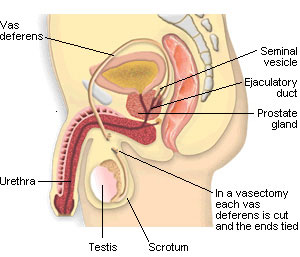
The process of sterilization which is carried out on men is known as vasectomy. After undergoing this process men may permanently lose their fertility and may not be able to make a woman pregnant. The process of vasectomy is done by cutting, blocking or tying the tubes that help to transport the sperms to the penis. This surgery prevents men to from producing semen which is a fluid that is produced by men after having sex thereby preventing pregnancy. Like female sterilization, this surgery too destroys the fertility of men forever. Therefore, it is a must to think wisely before opting for this surgery.
Is Surgical Sterilization Reversible?
Some men and women change their minds and ask to have their "tubes untied." Statistics show that only a very small percentage of such people have been able to conceive. There have also been rare cases of the Fallopian tubes rejoining. Tubal ligation using metal clips and rubber bands has greater potential for reversibility.
Rarely does pregnancy occur after a tubal ligation. This is not necessarily because the surgery has failed. More likely, the woman was pregnant at the time of surgery so the purpose was already defeated. It is advisable to do a pregnancy test prior to surgery. To be on the safe side, schedule the sterilization operation within the first two weeks following the start of a normal period.
Sorry. Due to our site's regulations and policies, your message has not been posted. Our moderating team has been notified about your message. If the message is found to be genuine and still did not get posted, you may not post the message again as it will automatically get posted for you within 24hrs time (excluding weekends).
- The Indiaparenting Team
Sterilization is a permanent method of contraception. One should consider it only when family planning is complete. the decision to reverse the procedure does not yield positive results.